It’s Bravo Superbowl week, and I’m kicking off a new series. Influencer Brands & Longevity. Because I’ve been under the hood of a lot of brands now, and I see a common thread: follower count doesn’t equal revenue. And it definitely doesn’t equal profit. The followers-vs-profit gap, and why a 25x return was never going to math.
First case study: LoverBoy.
Before we go anywhere, I never want to see a business fail, especially one with a founder this passionate. Kyle Cooke has put his name, his money, his family, and his marriage on this balance sheet. Running a business has its peaks and its lows, lonely days and thrilling ones — all at the same time.
Founders are passionately, lovingly insane. And sometimes that creativity looks like very publicly stress-DJing your way through a debt spiral on national television.
)%20(1).gif)
This week on Summer House, Kyle casually reminded viewers that he personally guaranteed a multi-million-dollar SBA loan. Which means if LoverBoy collapses, the debt doesn’t just magically disappear. It follows him.
So out of my own curiosity and love for product-based businesses, I wanted to try to peel back what’s going on. Did he try to scale something faster than the unit economics could carry?
How did a brand with a huge platform end up here?
I hate to admit this, but.. Bravo isn’t Hollywood status (well, in MY house it is). But unfortunately, I have had to compare Kyle Cooke to George Clooney today. And, as a Bravo viewer, I can’t say my drink of choice is a “hard tea with no sugar”. Would I watch Ocean’s 8, 11 or 12 with a Casamigos… probably.
So let’s look at LoverBoy and everything we know, to make sense of it all.
The numbers, from LoverBoy himself
One thing we know is that Kyle Cooke personally guaranteed a $4.2 million SBA loan. He is roughly five years into a ten-year term. He has paid down about $1.3 million. The remaining balance he is personally on the hook for is $2.9 million.1
To service that loan, LoverBoy needs to clear roughly $100,000 a month after tax, just to make the payment.2 On Summer House Season 10, Kyle disclosed that the brand lost as much as $175,000 in a single month, while still owing a mandatory monthly loan payment that has been reported as high as $150,000.3
On top of the SBA loan, Kyle has personally injected $500,000 of his own money into LoverBoy and stopped collecting a salary.4 He’s also taken money from friends and family, at one point promising them a 25x return. (Which we’ll return to later, because there’s a reason he may have thought that was a good stab in the dark.)5
The company has scaled down from around 30 employees and 200-plus distribution agreements to three full-time employees.6 On a March 2026 episode, Kyle said the cash on hand was enough for “six months at most.”7
How a $7M-funded brand got here
LoverBoy launched in 2018. Founder and CEO: Kyle Cooke, wife Amanda Batula as Creative Director and friend Carl Radke as an early investor and Sales team member. The product is a hard sparkling tea at 4.2% ABV, 90 calories, zero sugar, monk-fruit sweetened. The category fit is fine. The category itself? Well, that’s coming…
The funding history, per PitchBook and Tracxn:9
- August 2019 - $1M Seed
- May 2020 - $1M Seed
- April 2022 - $3.5M Series A
- Total disclosed: ~$7.66M across the rounds
Investors on the cap table include Republic Capital, Broken Arrow Holding, Riverside Ventures and Roark’s Drift.10 On top of that institutional money sits the SBA loan, the personal injections, and the friends-and-family round Kyle has spoken about openly.
By 2022, the brand was reportedly doing $16 million in sales.11 That is the part of the story everyone clips. The part nobody clips is the margin underneath that number, what’s left on the table to fuel the cash flow you need for stock, in larger amounts, the cost of national distribution, plus the cost of the marketing engine required to keep velocity moving on shelf and on D2C.
Top-line revenue can grow, and the business can still be bleeding. In alcohol, slotting fees, distributor margins, three-tier laws and chargebacks usually eat the P&L alive. You’re also at the hands of distributors, since it’s a market still reliant on traditional retail, bar and nightlife partnerships.
The 25x story
On Summer House this week, Kyle told us he’d told early backers he could deliver a “25x return.” Once he said it, something clicked, and I knew I wanted to write this.
In celebrity alcohol math, that number actually isn’t insane. Casamigos sold to Diageo in 2017 for up to $1 billion. Aviation Gin sold north of $600 million in 2020. If you got in early on either, your 25x looked conservative.
But Casamigos was Clooney, Gerber and Meldman. Aviation was Ryan Reynolds plus a deeply operational team. The celebrity part was a distribution and trust accelerant — not the engine. The engine was world-class operators, real liquid quality, and being early into a category that was rocketing (premium tequila and craft gin, respectively).
LoverBoy launched into the RTD wars in 2018. White Claw had already exploded. Truly was two years in. The category Kyle entered didn’t have $1B exit oxygen by 2022. It had shelf-space cannibalism, distributor consolidation, and a consumer who is, measurably, drinking less.
Which brings me to the part of this story I think is being under-discussed.
Casamigos is selling to a 38-year-old. LoverBoy is selling to Gen Z. That math is brutal right now.
Casamigos is marketed to an older, premium-but-accessible spirits demographic. That consumer is still happily spending on alcohol.
LoverBoy is speaking to a much younger consumer — late Gen Z, TikTok-adjacent, wellness-coded, Bravo-superfan-adjacent — and that consumer is measurably drinking less. 41% of Gen Z says they’d rather go to a sober bar. Carl is certainly not a mess. Soft Bar might actually be booming.
So the audience LoverBoy is courting hardest is also the audience increasingly questioning alcohol altogether. That’s a category problem the best Instagram engagement rate on earth cannot fix.
And then there’s the bigger disconnect. LoverBoy’s creative — the fonts, the colours, the social grid, the whole energy — is styled toward a young, Gen Z-adjacent consumer. But the actual consumer Bravo is delivering is a millennial-to-Gen-X woman with disposable income, drinking wine on the couch, watching Summer House on a Sunday night.
I know this because I am her. She is me.
The brand creative is doing handstands to look like Poppi, which makes sense for Poppi, because it’s a no-alc soft drink disrupting Coke, Pepsi and Sprite. LoverBoy is trying to use the same visual language to sell alcohol to a generation increasingly moving away from it. And honestly? LoverBoy is barely speaking my language on the can. I want a wine or cocktail from my built-in bartender (my husband).
If I were sitting in the LoverBoy office tomorrow, I’d split the creative entirely. Keep the youthful, Gen-Z-adjacent identity for TikTok and festivals. But build a second, more elevated system for the Bravo audience already buying wine and cocktails every week. Slightly more for pouring or hosting, probably not in a can — glass, no-sugar cocktail mixes, similar to Mr Consistent. Slightly more premium. Slightly less “hard tea for 23-year-olds standing in a festival line.”
Because right now, the audience paying the slotting fees is barely being spoken to.
Who did this right? Poppi.
Same demographic. Same colourful can. Same TikTok-native energy. Same launch decade. Different category.
Allison Ellsworth brewed early versions of Poppi in her kitchen in 2015, maxed out her credit cards, sold her car, and pitched on Shark Tank in 2018 — nine months pregnant — walking away with $400K for 25%. By 2020, she’d rebranded to Poppi, dropped the glass for the colourful can, and leaned hard into TikTok. Five years later: $500 million in annual revenue.
In March 2025, PepsiCo announced the $1.95 billion acquisition — a net $1.65B after anticipated cash tax benefits. Closed May 2025. The Ellsworths owned roughly 12% at exit — approximately $150 million post-tax to the founders.
Read those numbers back-to-back with the LoverBoy section. Same launch decade. Same visual language. Same Gen Z and millennial-woman target. Same exact consumer. Poppi sold that consumer a healthy, TikTok-pretty product without alcohol. LoverBoy is selling the same demographic the same-shaped can with alcohol inside it.
One of those bets aged like it was prophetic. The other is being run on a personal guarantee and a DJ tour.
Category and product are the variables. Not branding. Not founder energy. Not the hustle. Not the platform.
Distribution story
Interesting note — LoverBoy has reportedly been built with “zero ad spend” on a podcast. Which implies the strategy was always retail-first, not DTC-first.
Here’s what’s true about LoverBoy’s footprint (I’m not 100% on the door counts; this is pulled from public data, which I doubt is fully accurate):
- Nationwide distribution at Walmart — nearly 1,500 stores
- Chainwide rollout across all 237 Total Wine & More stores
- Selective presence in Whole Foods, Kroger, Walgreens and certain Target stores
- DTC across 44 US states
- Zero international distribution (I can’t verify)
With all this retail, why is LoverBoy in debt? Because being on the shelf has slotting fees, end-cap programmes and category-manager reviews that cost real cash up front. If velocity doesn’t hit benchmarks, the SKU gets cut at the next reset — and in the meantime, you’ve already paid, or you’re waiting on lengthy retailer payment terms for stock you fronted at large volume to win the contract. There’s also typically only a 50% margin — standard retail split — before product, operating and marketing costs.
This is exactly why I’ve watched brands with fewer than 3,000 Instagram followers quietly out-earn brands with 300,000+ at a profit. The 3K-follower brand isn’t paying $40K for an end-cap. They’re selling through Shopify with a high DTC revenue split, maintaining full margin before marketing and ops costs, and using repeat-purchase email and SMS to do the heavy lifting. The 300K-follower brand often looks bigger and loses money faster. The smaller brand controls its customers, sales and costs end-to-end.
Followers and retailers are top-of-funnel signals. They are not a balance sheet. It takes a lot of money to get to those numbers — and followers don’t equal sales.
Why celebrity- and influencer-led brands are usually a short-term play
Not universal. But the pattern is consistent enough that I’ll stake my reputation on it.
A founder with a large platform can compress the top of the funnel dramatically. They cut the cost of awareness for new launches in half overnight. What the platform cannot do is:
- Fix bad unit economics
- Fix a category-and-product timing problem
- Train operators, build supply-chain redundancy, negotiate a co-packer agreement
The brands that do break out — Rhode (Hailey Bieber), Fenty (Rihanna), Skims (Kim Kardashian), Casamigos — share two non-negotiable things: exceptional operators behind the scenes, and a product the category genuinely wanted. The celebrity is the matchstick. They drive momentum and solve cash-flow hurdles at the start. Customers stay for the product. When you don’t have both, the fire goes out.
So… can LoverBoy get out of it?
Here are a few possibilities:
1. A strategic acquirer takes the brand on. Most likely buyer profile: a regional beverage holding company, a private-label spirits group, or a roll-up consolidator looking for shelf-space leverage. The headline price will not be a Casamigos number. It’ll be a multiple of revenue, almost certainly with assumption of the SBA debt or a discount to net it out. Kyle’s name and Bravo’s cultural equity have some value — but they’re a brand asset, not the asset.
2. A debt restructure plus operational reset. Convert the SBA position, raise a small bridge from existing investors at a punishing valuation, cut SKUs, retreat from retail aisles where velocity is below threshold, and run the brand as a high-margin DTC + select-retail business with a fraction of the team. This is what “three employees” actually looks like in practice — the team they always should have been at this revenue level.
3. Bankruptcy and brand-asset sale. Chapter 11 allows the operating entity to discharge debt while brand IP, customer list, and retail relationships are sold to a buyer who can rebuild without the drag. The painful part: Kyle’s personal guarantee doesn’t vanish in a corporate bankruptcy. That’s the lever pinning a lot of founders to a desk they should have walked away from a year earlier.
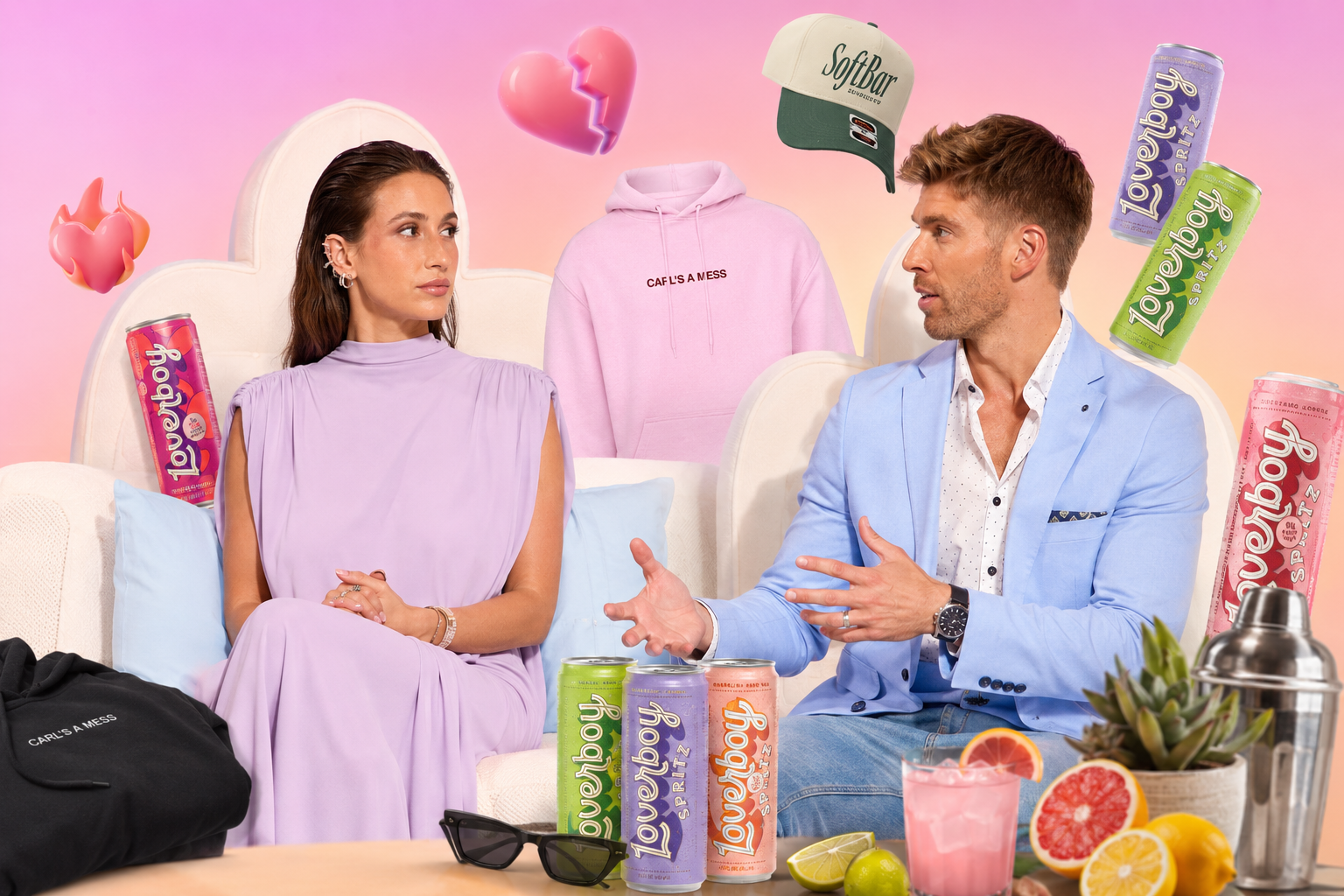
4. The “Summer House” and “In the City” lifeline. Kyle has, by his own account, been kept alive by a fan-driven sales bump tied to the “Carl’s a Mess” merch and the In the City spinoff. It’s real revenue — but it’s fundamentally unstable, because it relies on the next season being interesting enough to drive the next sell-through. Televised lifelines buy months, not years.
That said, I do think platforming the business turnaround itself on “In the City” could be a fab play. Kyle has already broken the fourth wall on the company’s finances and current state. And honestly? I was interested enough to write this. The audience is already in the room.
We need more of this… real footage of real brands, not the Selling Sunset and Kardashians-of-the-world version showing unrealistic numbers and over-polished BTS. The unfiltered version is more relatable to real businesses.
5. Vegas residency and DJ gigs(my favourite). Amanda may not have been on board, but Kyle can leverage his cultural footprint by placing LoverBoy inside moments that don’t require a slotting fee. Nightclub venues. Festivals. Hotel mini-bars. Boat parties. Cultural distribution is a real distribution model and influencer-led brands criminally under-deploy it. I’m loving the Vegas residency — and I hope it’s part of the agreement so Kyle can bring his salary back.
Kyle is taking a real, sustained, public financial beating and somehow looks 15 years younger. I’m taking notes. Kyle, what’s the preventative routine? Because if I’m 43 and in a different debt cycle of my own, I’d love to be DJing in Vegas, looking fresh out of an oxygen chamber, too.
The takeaway
Kyle’s openness about the financials is the most quietly important business commentary on Bravo right now. He’s letting millions of viewers watch what a personal guarantee on an SBA loan looks like at month sixty. He’s showing them what it looks like to inject your last $500K, stop paying yourself, DJ on the side, and watch your business partner build the better-positioned brand right next to you.
Most founders never tell you any of this. Most are running the same maths, hustling alone on a Friday night to make sure the business performs over the weekend.
So for any founder thinking about taking on a celebrity partner, or the influencer thinking about launching their own brand, the only question that matters:
How long before the celeb platform stops covering the business, and what will the rest of the growth engine cost?
Because the platform always stops eventually. The followers move. The season ends. The demand is unstable and hard to predict. When it does its thing, the only things left are the unit economics, the distributor agreements, the gross margin, the cap table and the loan calls.
I didn't answer my main question: if Kyle can get the role of Roxie Hart, will LoverBoy be the drink of choice in next season's Chicago? (Bravo's scandal-to-Broadway pipeline is officially a thing now, our Queen Ariana.) <3